Germany’s nuclear exit was delayed to this year after Moscow’s invasion of Ukraine wreaked havoc in energy markets.
Germany nuclear power plant
A general view shows the Neckarwestheim nuclear power plant, as Germany shuts down its last nuclear power plants [Heiko Becker/Reuters]
Published On 15 Apr 2023
15 Apr 2023
Germany will switch off its last three nuclear reactors on Saturday, exiting atomic power even as it seeks to wean itself off fossil fuels and manage an energy crisis caused by the war in Ukraine.
While many Western countries are upping their investments in atomic energy to reduce their emissions, Germany is bringing an early end to its nuclear age.
KEEP READING
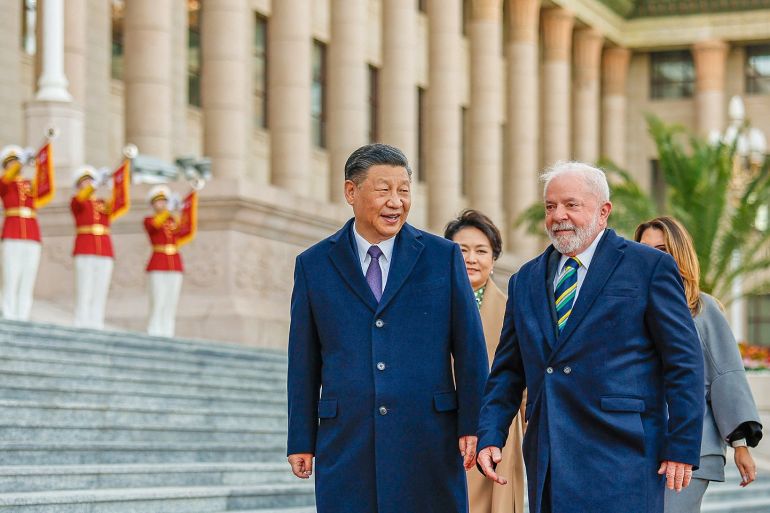
The presidents of Brazil and China have pledged to bolster cooperation between their two countries, as Luiz Inacio Lula da Silva and Xi Jinping held in the Chinese capital.
The meeting on Friday in Beijing came on the second day of Lula’s visit to China, the South American nation’s most important trading partner.
KEEP READING
Following years of prevaricating, Germany pledged to quit nuclear power definitively after Japan’s 2011 Fukushima disaster sent radiation spewing into the air and terrifying the world.
But the final wind-down was delayed from last year to this year after Moscow’s invasion of Ukraine prompted Germany to halt Russian fossil fuel imports. Prices soared and there were fears of energy shortages around the world – but now Germany is confident again about gas supplies and expansion of renewables.
The exit decision was popular in a country with a powerful anti-nuclear movement, stoked by lingering fears of a Cold War conflict and atomic disasters such as Chernobyl in Ukraine.
“The risks of nuclear power are ultimately unmanageable,” said Environment Minister Steffi Lemke, who this week made a pilgrimage to the ill-fated Japanese plant in advance of a G7 meeting in the country.
Germany nuclear protest
A Greenpeace activist takes part in a protest against nuclear power as Germany shuts down its last three nuclear power plants [Nadja Wohlleben/Reuters]
But the challenge caused by Russia’s invasion of Ukraine, which put an end to cheap gas imports, and the need to quickly cut emissions has upped calls in Germany to delay the withdrawal from nuclear power.
Greenpeace, at the heart of the anti-nuclear movement, organised a celebratory party at the Brandenburg Gate in Berlin to mark the occasion.
“Finally, nuclear energy belongs to history! Let’s make this April 15 a day to remember,” the organisation said.
In contrast, conservative daily FAZ headlined its Saturday edition “Thanks, nuclear energy,” as it listed the benefits it said nuclear had brought the country over the years.
Sign up for Al Jazeera
Week in the Middle East
Catch up on our coverage of the region, all in one place.
E-mail address
Sign up
By signing up, you agree to our Privacy Policy
‘A mistake’
Initially planned for the end of 2022, Germany’s nuclear exit had already been pushed back once.
As Russian gas supplies dwindled last year, officials in Berlin were left scrambling to find a way to keep the lights on, with a short extension agreed until mid-April.
Germany, the largest emitter in the European Union, also powered up some of its mothballed coal-fuelled plants to cover the potential gap left by gas.
https://app.eventsframe.com/app/event/5109708086050816/
https://community.oppo.com/thread/1310256525415022600
https://community.oppo.com/thread/1310259376342171652
https://app.eventsframe.com/app/event/6263364219043840/
https://app.eventsframe.com/app/event/5160449500774400/
https://movieshdtaiwanfoxsmw.statuspage.io/
https://taiwanmoviesboxoficetw.statuspage.io/
https://beauisafraidonlinehkbox1.statuspage.io/
https://beauisafraidhdyahootw.statuspage.io/
https://infogram.com/-2023-hd-1h7z2l89zx59g6o
https://infogram.com/2023-hd1080p-1h7j4dvrx7e394n
https://community.oppo.com/thread/1310282680549507075
https://community.oppo.com/thread/1310287497648930818
https://rideontiongkokmovieshdq.statuspage.io/
The challenging energy situation had increased calls domestically for the exit from nuclear to be delayed.
Germany had to “expand the supply of energy and not restrict it any further” in light of potential shortages and high prices, the president of the German chambers of commerce, Peter Adrian, told the Rheinische Post daily.
The conservative leader of Bavaria Markus Soeder meanwhile told the Focus Online website that he wanted the plants to stay online and three more to be kept “in reserve”.
Outside observers have been similarly irked by Germany’s insistence on exiting nuclear while ramping up its coal usage, with climate activist Greta Thunberg in October slamming the move as “a mistake”.
Play Video
Video Duration 27 minutes 00 seconds
27:00
Why has Germany shut down its nuclear plants? | Inside Story
At the Isar 2 complex in Bavaria, technicians will progressively shut down the reactor from 10:00 pm (20:00 GMT) on Saturday, severing it from the grid for good.
“It will be a very moving moment for colleagues to shut down the power plant for the last time,” said Guido Knott, CEO of PreussenElektra, which operated Isar 2, a few hours before the deadline.
By the end of the day, operators at the other two facilities, in northern Emsland and southwestern Neckarwestheim, will have taken their facilities offline as well.
The three final plants provided just 6 percent of Germany’s energy last year, compared with 30.8 percent from all nuclear plants in 1997.
“Sooner or later” the reactors will start being dismantled, Economy Minister Robert Habeck told the Funke group before the scheduled decommissioning, brushing aside the idea of an extension.
The government has the energy situation “under control”, Habeck assured, having filled gas stores and built new infrastructure for the import of liquefied natural gas to bridge the gap left by Russian supplies.
Instead, the minister from the Green party, which was founded on opposition to nuclear power, is focused on getting Germany to produce 80 percent of its energy from renewables by 2030.
To this end, Chancellor Olaf Scholz has called for the installation of “four to five wind turbines a day” over the next few years – a tall order given that just 551 were installed last year.
SOURCE: NEWS AGENCIES
Komentar
Posting Komentar